Speakers

Denise McCreanor

Parallel Workshops
People living in prison experience significant and persistent health inequalities, including higher rates of chronic illness, disability, and premature mortality. These challenges are intensified by ageing prison populations, high levels of remand, and fragmented care pathways. In Northern Ireland, the absence of formally commissioned social care within prisons further complicates the delivery of equitable, community‑equivalent healthcare for individuals with complex physical and palliative needs.
HMP Maghaberry, Northern Ireland’s largest and most complex prison, has experienced a substantial increase in people presenting with long‑term conditions, functional impairment, and complex health needs. Historically, unmet need resulted in prolonged hospital admissions, delays in discharge, inappropriate emergency department attendance, poor continuity of care between custody and the community, and increased clinical and operational risk.
In response, Healthcare in Prison developed a pilot Complex Care Coordinator role, led by experienced nursing staff with backgrounds in both community and custodial healthcare. The role provides a single point of oversight for individuals with complex needs, supporting proactive identification, assessment, and coordination of care across prison, acute, and community settings. Working in partnership with the Northern Ireland Prison Service, multidisciplinary healthcare teams, hospitals, community services, and independent care providers, the model reduces fragmentation, strengthens continuity, and promotes patient‑centred care despite significant policy and commissioning constraints.
This panel discussion will explore the development, implementation, and impact of the complex care coordination model, offering transferable learning for international correctional healthcare systems seeking to improve transitions of care and deliver more equitable, humane health services for people in prison.

Denise McCreanor is the Lead Nurse at HMP Maghaberry and has held this role for the past four years, providing clinical and professional leadership to a diverse primary care nursing team within Northern Ireland’s most complex prison. During this time, she has led services through an exponential rise in both the volume and complexity of healthcare need, including a growing cohort of older people in prison with significant physical health, disability, and long-term conditions.
Denise has been central to developing patient‑centred responses to these challenges, navigating complex commissioning arrangements and policy constraints, particularly in relation to the provision of social care within a custodial environment. Through strong clinical leadership, advocacy, and collaborative working, she has consistently focused on maintaining safety, dignity, and equity of care for individuals whose needs often extend beyond traditional prison healthcare models.
Her work reflects a sustained commitment to improving outcomes for people with complex needs in custody and to leading innovation in prison healthcare delivery.
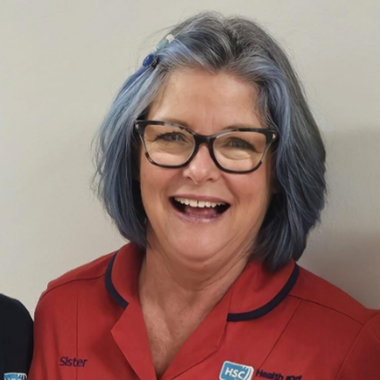
Wanda Walsh is a Sister within the Primary Care Team at HMP Maghaberry and has worked in prison healthcare for a number of years. She currently undertakes the pilot role of Complex Care Coordinator for Healthcare in Prison, a role shaped by her extensive nursing experience across both community healthcare settings and the prison environment.
Drawing on this breadth of experience, Wanda played a central role in developing the complex care coordinator function, designed to address the needs of people in custody with additional physical healthcare requirements. Working in close partnership with Northern Ireland Prison Service (NIPS) staff and Healthcare in Prison (HIP) colleagues, she identifies individuals—often at the point of committal—who have complex long‑term conditions, significant physical health needs, or palliative care requirements.
Wanda works across the system to ensure these needs are recognised and met, establishing strong connectivity with acute and community services to promote continuity and consistency of care. She collaborates closely with the multidisciplinary healthcare team within the prison to coordinate assessment, planning, and delivery of care across custodial and non‑custodial settings.
Her empathetic, collaborative, and highly professional approach to patient‑centred care led to her selection as a finalist in the Royal College of Nursing (RCN) Nurse of the Year Awards, Northern Ireland 2025, in the Public Health category.