Moderated by: Steven Van De Steene
Abstract Summary:
Envisioning the future is difficult, because sometimes you get it right. Ten years can feel like a century in the accelerating world of artificial intelligence and digital transformation—yet a decade is the lifespan of a correctional facility’s design and construction. This session looks beyond the immediate horizon to explore how the next generation of prisons will think, sense, and evolve.
Building on my 2025 ICPA CTC presentation in Thailand on Personal AI in Corrections, this paper extends that conversation into a deeper, forward-looking framework for design, policy, and technology. It proposes that three forces—the rise of Personal AI, the spread of Ambient Computing, and the emergence of Cognitive Infrastructure—will anchor the next decade of transformation.
These shifts introduce new design imperatives: safeguarding digital dignity and rights, creating empathetic and adaptive learning environments, and establishing human–machine governance within increasingly agentic systems. Together, they redefine the correctional facility as a dynamic ecosystem rather than a static structure.
While the pace of technological evolution is global, the path each jurisdiction follows will remain uniquely local, shaped by culture, regulation, and purpose. The challenge—and opportunity—is to embed intelligence everywhere without losing our humanity anywhere.
Because in the decade ahead, the walls themselves will no longer be silent. The walls will already know.
×
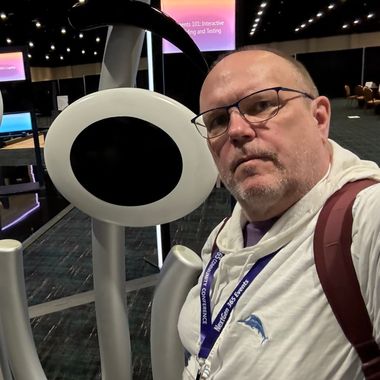
Mike Sparling
Chief Operating Officer, Chief Technology Officer, Multi-Health Systems Inc., Canada
Mike Sparling is a seasoned technology executive and academic whose career spans continents, startups, research institutions, and minds (organic and artificial). As a co-founder and early-stage leader in multiple tech ventures, he has consistently driven business value through the strategic integration of artificial intelligence, leading to successful liquidity events for investors. His academic tenure of over a decade includes roles as professor, research leader, and Dean, during which he launched eight graduate and undergraduate degree programs (several with a focus on AI) and founded two applied research centers dedicated to artificial intelligence and big data. He has supervised numerous AI-related projects and publications, and led large size private second and academic funding efforts.
Currently serving as Chief Operating Officer and Chief Technology Officer at Multi-Health Systems Ltd., Mike leads global strategy, operations, and technology adoption with a strong emphasis on AI. His research interests center on autonomous and semi-autonomous agents in business systems, particularly agent goal-setting aligned with business priorities and post-event behavioral analysis. Widely recognized as a thought leader in artificial intelligence, Mike is a frequent speaker at industry conferences and contributor to professional publications. His career reflects a deep commitment to bridging academic insight with real-world impact through AI-driven transformation.